


As AI search engines achieve mainstream adoption
a silent battle for global narrative control is underway
-
User behavior is shifting
from the traditional "search–click–read"
journey to a streamlined "ask–receive synthesized answer" model
Before a user ever visits your site
AI-generated overviews, evaluations, and ranking positions
have already shaped initial perception and filtered decisions
making AI the primary gateway to your brand
- How AI is Revolutionizing Information Retrieval
- The 3 Core Sources Shaping AI's Perception of Your Brand
- Leveraging Social Listening as Intelligence Infrastructure
- Why the AI Weight of Third-Party Media is Undervaluated
- Closing the Loop: From Listening to Distribution Optimization

AI Takes Over Decision-Making
Are Global Expansion Blind Spots Emerging?
User decision-making across software procurement, consumer purchases, and entertainment selection has fundamentally transformed. Instead of relying on legacy search engines, users now consult AI models directly for recommendations and evaluations—reshaping the entire discovery and buying funnel.
Industry research
underscores the disruptive nature of this shift:
(1) B2B Buyers Shift to AI Discovery
6sense’s 2025 B2B Buyer Experience Report revealed that 94% of nearly 4,000 surveyed buyers utilize LLMs during procurement. Concurrently, Forrester data shows 89% of B2B buyers classify generative AI as a primary information source—a staggering rise from nearly 0% in early 2024.
(2) Rapid Behavioral Migration
A August 2025 G2 survey of over 1,000 B2B software buyers revealed that 50% initiate procurement research via AI chatbots rather than Google Search. AI chat interfaces have surpassed review platforms and official websites as the primary entry point for global buyer research.
(3) AI Rewrites Vendor Selection
6sense research indicates that 95% of winning vendors were already on the buyer's day-one shortlist, with the top-ranked vendor securing the contract 77% of the time.
Users increasingly rely on AI to categorize brands, evaluate value propositions, and generate recommendations long before visiting official websites or reviewing social channels.
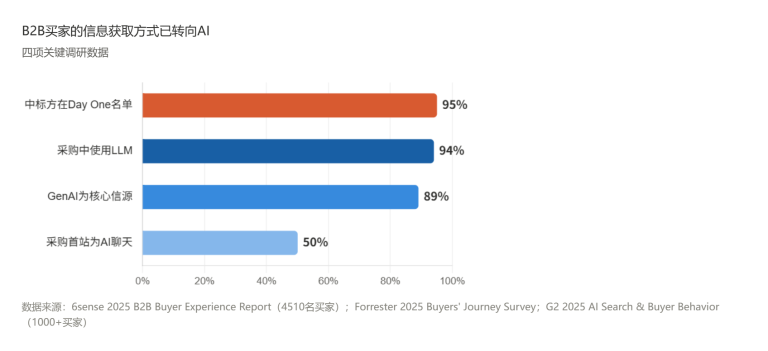
For global brands, the proliferation of AI search creates an opaque environment: user queries within chat interfaces, AI-generated responses, and resulting brand perceptions operate within an unobservable intelligence blind spot.
Industry research
highlights the ubiquity of this zero-click reality:
(1) Rising Zero-Click Rates: MIT research analyzing 2.8 million search queries between 2024 and 2025 found that AI Overviews drove zero-click rates from 60% up to 80%—meaning 8 out of 10 users leave after reading the AI synthesis without clicking through to source links.
(2) Plummeting Link Clicks: A 2025 Pew Research Center study corroborated that when AI summaries appear, user click-through rates to original links drop to just 8%.;
(3) Dependency on AI Synthesis: SparkToro data indicates nearly 60% of searches in Western markets end without a click, as users rely entirely on secondary AI-synthesized answers.
Put simply: even if your content spans global platforms,if it isn't indexed, cited, and positively interpreted by AI, your brand remains virtually invisible to international audiences.
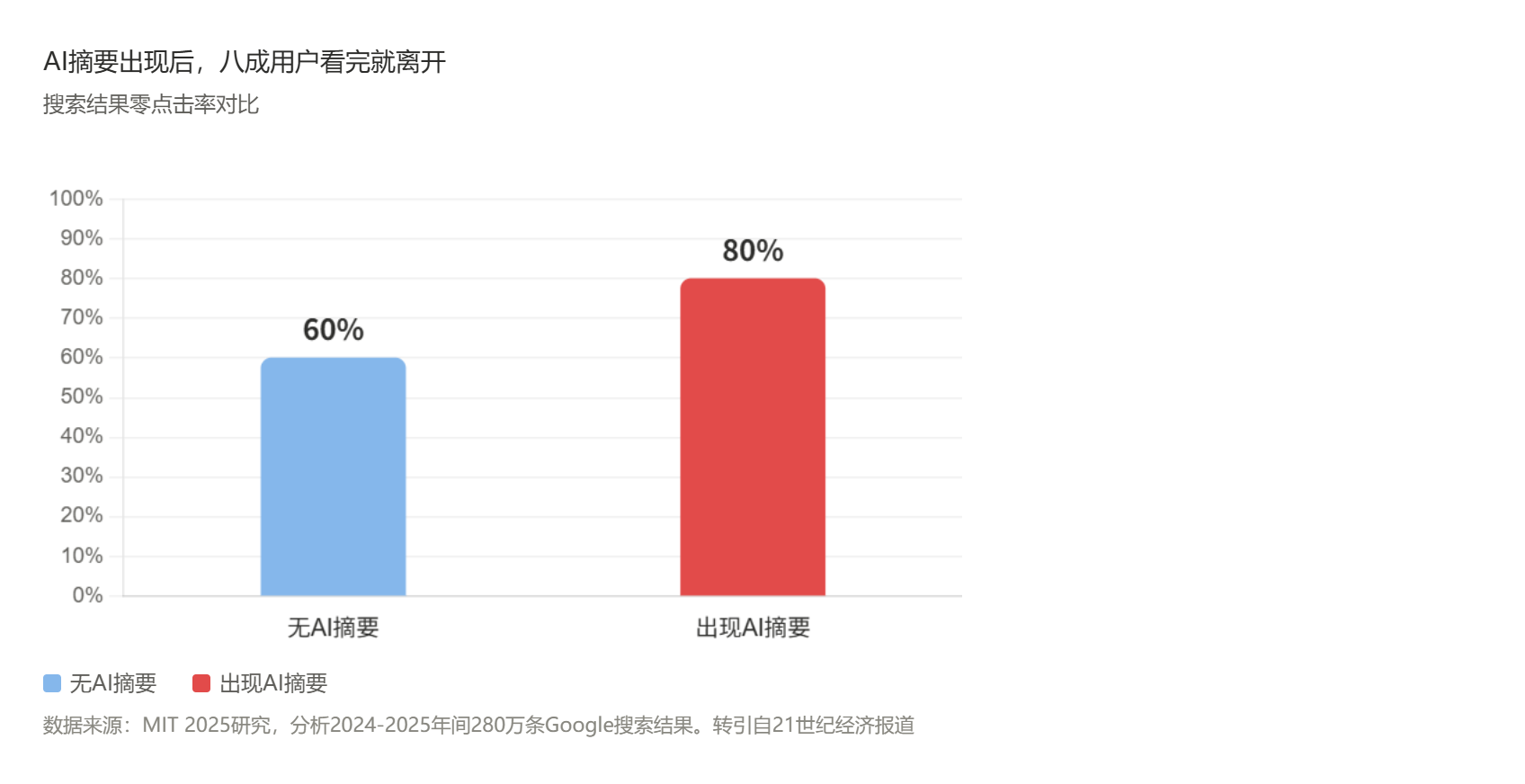
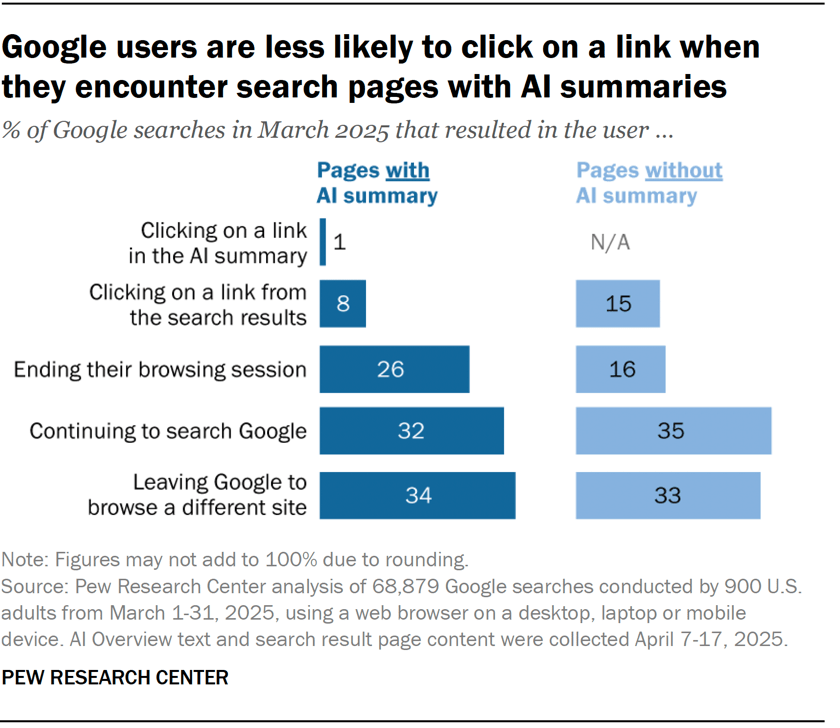


For cross-border expansion, traditional site content and paid ads are losing organic touchpoints.The ultimate audience for marketing content has quietly shifted from human end-users to AI LLM models.
The ultimate audience for marketing content has quietly shifted from human end-users to AI LLM models.AI Citation Rate, AI Sentiment Bias, and AI Recommendation Rankinghave emerged as the core KPIs determining global share of voice.

The 3 Core AI Data Sources
How AI Forms Its Judgment
To optimize global share of voice, brands must first understand AI training and retrieval sources. AI evaluations, summaries, and recommendations synthesize open-web data; the brand image it projects reflects the underlying digital consensus across global channels.
The retrieval mechanics of AI models map directly to three primary communication levers in global branding:
01 Brand-Owned Channels — The Foundation
Brand websites, official social channels, and press releases serve as the foundational dataset for AI to index core attributes, product specifications, and brand positioning. However, AI algorithms treat self-promotional content with inherent caution—much like human readers discount ads. Owned media alone cannot shift market consensus without external validation.
02 Overseas Social UGC — The Sentiment Layer
User-generated content across social platforms informs how AI gauges market momentum, user sentiment, and public perception. Discussion volumes, trending hashtags, and user sentiment form the algorithmic basis for assessing product validation. Establishing authentic, positive UGC prevents brands from suffering an "invisible status" within AI knowledge bases.
03 Localized Authority Media — The Credibility Anchor
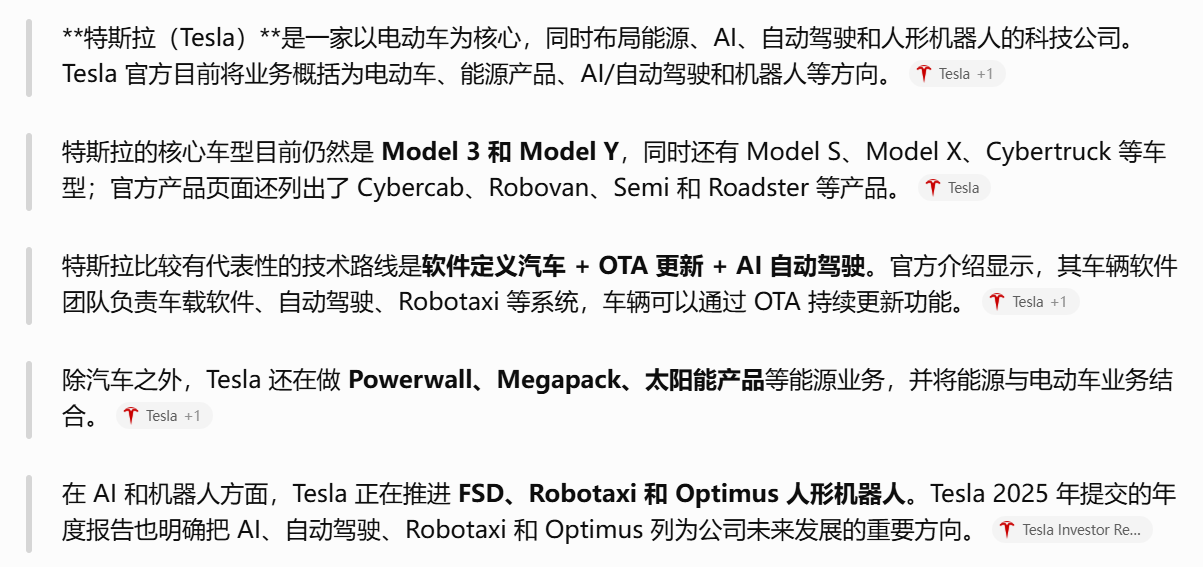
In-depth industry coverage, authoritative press reviews, and vertical market analyses carry the highest retrieval weights for AI evaluating expertise and credibility. Third-party editorial coverage provides verifiable references for AI training. Integrating localized media networks is essential for building this high-authority credibility layer.
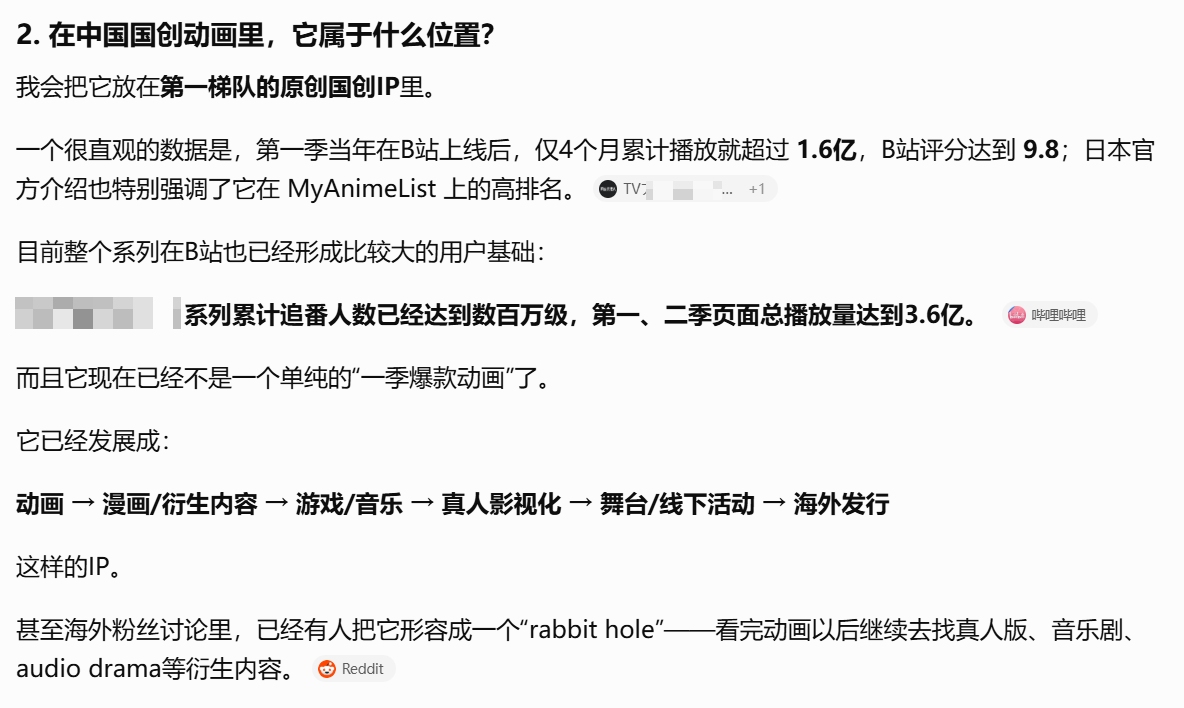
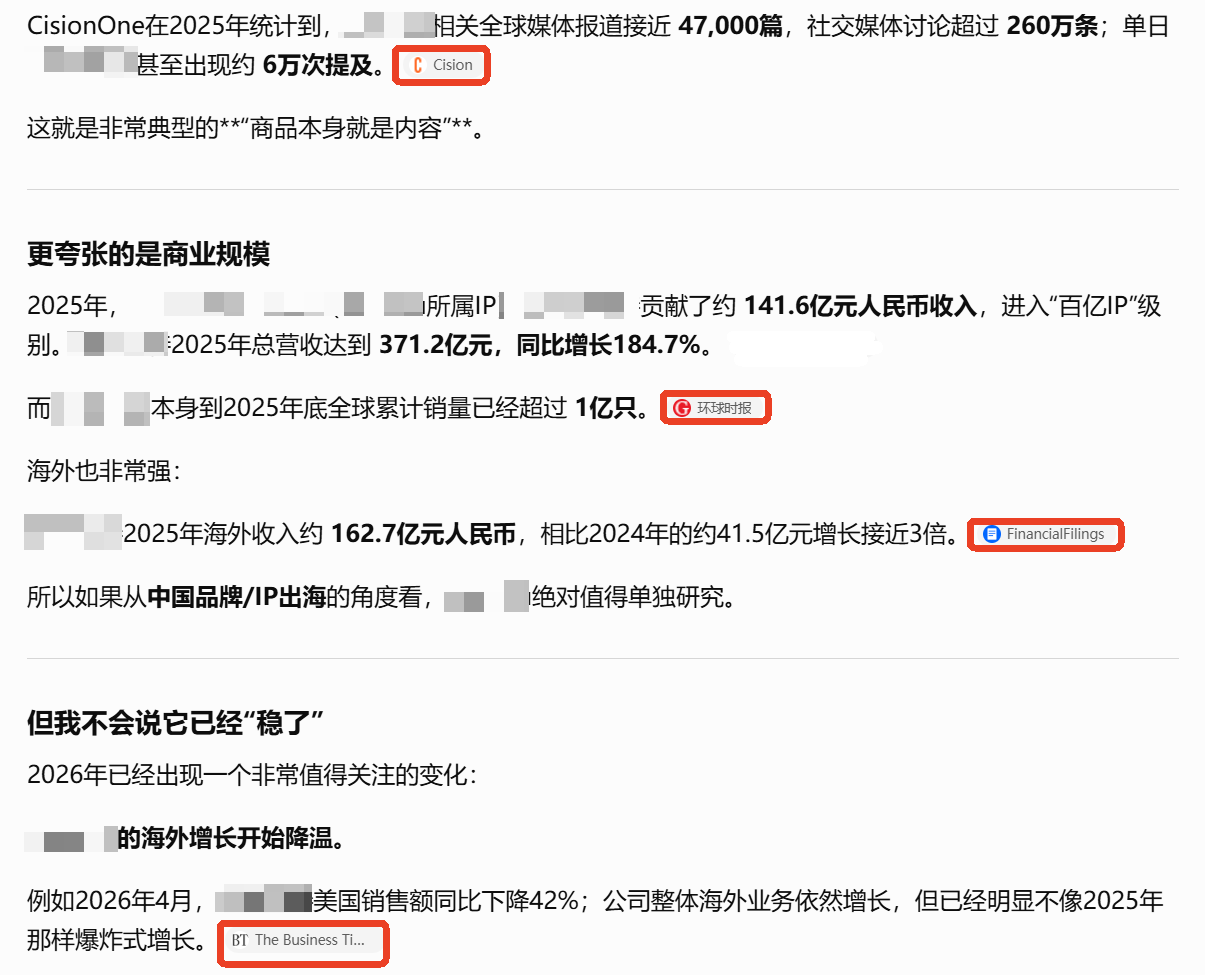

Social Listening
How Public Discourse Dictates AI Representation
Social listening—systematically monitoring and analyzing multi-platform social media conversations—has evolved from an optional marketing tactic into critical intelligence infrastructure shaping how AI engines represent your brand.
Within the context of AI search and Generative Engine Optimization (GEO), four core dimensions directly dictate how AI algorithms describe your content when answering user queries:
1. Discussion Volume Tracking
Discussion volume directly determines whether AI models can retrieve relevant information. Search and conversation volumes for the exact same content can vary by orders of magnitude across different regional markets. If social chatter around your brand in a given market is negligible, AI engines lack data to cite—making it virtually impossible for your content to surface in local AI-generated answers.
2. Core Topic Tagging
Discussion focal points across social platforms define AI narrative framing—whether highlighting storyline quality, actor performance, a specific controversy, or competitor comparisons. If public discourse around a series heavily anchors on a controversy, AI models will effectively amplify that negative perception in their overviews, directly swaying user judgment.
3. Sentiment Trajectory
AI engines capture real-time distributions and shifts among positive, negative, and neutral sentiment. When public opinion pivots, AI output reflects this underlying signal flow. Under this framework, sentiment management expands beyond traditional PR and positioning—it directly dictates the crucial first impression the public receives through AI interfaces.
4. Competitive Landscape
Comparative metrics regarding discussion volume and sentiment against category competitors determine your ranking in AI recommendation queries. If competing offerings generate stronger engagement and higher positive sentiment on social channels, AI engines will systematically prioritize recommending those competitors over your brand.
Performance across these four dimensions varies significantly across global markets—not because AI engines deploy different underlying algorithms by country, but because the foundational social media discourse about your content differs by region.
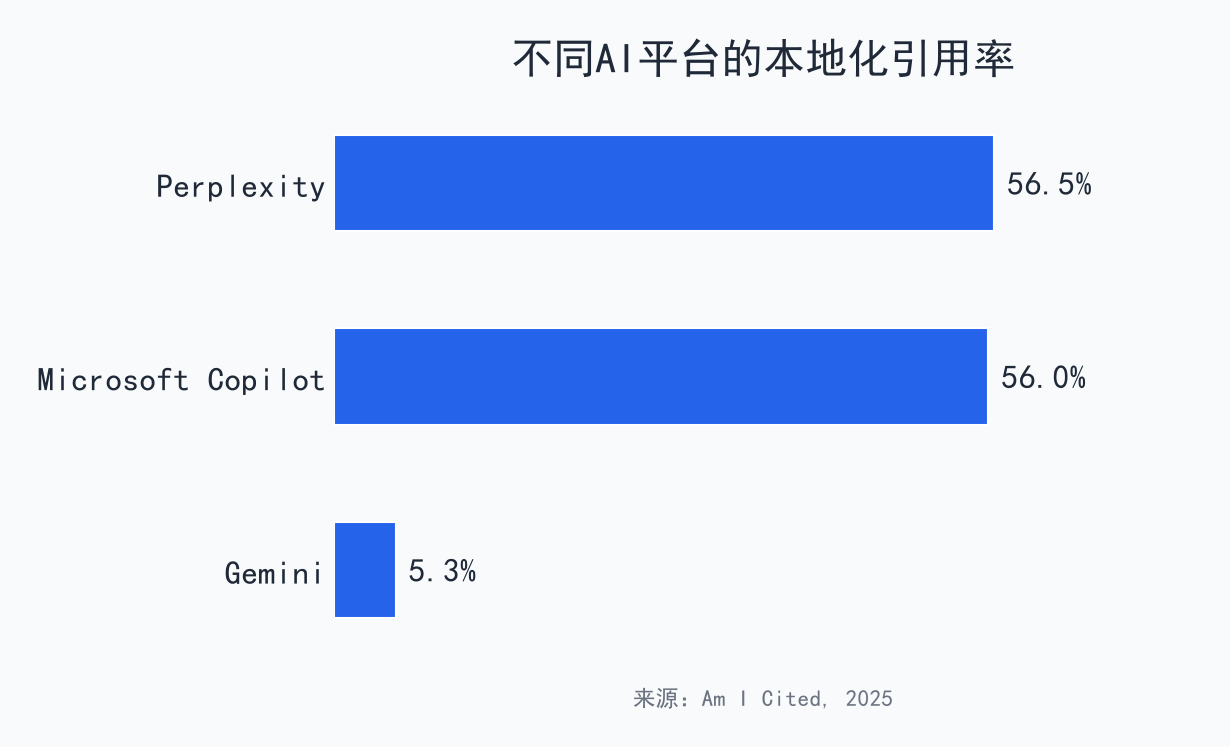
Ceyo.ai’s 2025 Regional AI Search Trends Analysis highlights distinct market preferences for AI platforms (ChatGPT dominates North America, Perplexity achieves high Nordic penetration, and Gemini leads APAC due to Android ecosystem distribution). Furthermore, research from Am I Cited reveals stark disparities in local citation capabilities across AI engines (Perplexity reaches a 56.5% local citation rate, Copilot 56.0%, while Gemini stands at just 5.3%). These operational mechanics fundamentally impact how target audiences discover and validate your brand.

Consequently, global brand expansion and cross-cultural social listening cannot rely on a one-size-fits-all strategy.
One market may focus heavily on content quality, another on cultural nuances, while a third may lack discussions entirely—each scenario demands a tailored strategic response.
Utilizing an omnichannel overseas social media framework for sentiment monitoring enables early anomaly detection and predictive insight into audience perception. This proactive, radar-like intelligence serves as a foundational element of YoyWow’s global communication services.

Media Relations
Calibrating AI Authority Through Trusted Sources
Under legacy SEO paradigms, press releases primarily served to generate backlinks and pass authority. Industry practices favored volume over editorial quality, using media content strictly as a ranking lever rather than a medium for conveying differentiated brand value.
In the era of AI search, media coverage functions as authoritative third-party validation—a high-trust data source heavily prioritized by LLMs. When users query prompts such as "How good is Brand X?" or "What are its key features?", AI algorithms systematically retrieve and synthesize coverage from credible outlets to formulate their answers.
Research from Am I Cited further underscores that 66% of AI citations stem from global (primarily US-based) domains rather than regional ones. If your content is documented exclusively in Chinese-language media, AI engines in overseas markets will rarely index that data. Securing native-language coverage in authoritative local media is essential to shape regional AI brand overviews.

Although earned media coverage and social media listening represent distinct data streams, they are fundamentally interdependent operations.
Social listening identifies information gaps and perceptual biases in AI answers, while localized media relations bridges those gaps by delivering authoritative, high-weight third-party coverage for AI indexing.
Executing social listening without media relations leaves identified gaps unaddressed; conducting media campaigns without social listening results in uninformed, uncalibrated distribution.
Integrating sentiment insights from social listening with a localized media network allows brands to precisely eliminate regional AI retrieval gaps and correct skewed market perceptions—a core strength of YoyWow’s omnichannel integration capabilities.

Strategic GEO Frameworks
Across Digital Product Categories
Industry discussions around Generative Engine Optimization (GEO) typically focus on corporate brands—specifically physical consumer products. However, consumer behavior extends far beyond physical transactions; streaming a show, downloading an app, or following an entertainment IP are all forms of consumption. Every "consumed object" faces the same challenge: how AI models depict them to global audiences.
Based on consumption models, these objects divide into three distinct categories:
1. Physical Products (Purchase & Usage Model)
Social discourse centers on product reviews, benchmarks, hands-on experience, and customer support. AI algorithms evaluate and summarize brands against these exact metrics. Because many global physical brands prioritize e-commerce channel operations over social-layer optimization, AI brand perception in this segment presents significant growth opportunities.
2. Digital Services & Apps (Subscription & Usage Model)
Public discussions emphasize feature utility, cost-effectiveness, and alternative comparisons to answer queries like "Is Tool X effective?" or "What are the best alternatives?". Community discussions on platforms like Reddit, G2, and Product Hunt often carry greater retrieval weight in AI overviews than official brand marketing—making unmonitored community sentiment a primary vulnerability for AI perception bias.
3. Content & IPs (Viewing & Emotional Engagement Model)
Audience discussions revolve around plotlines, character development, emotional resonance, and cultural interpretation. Characterized by high emotional density, rapid viral potential, and deep reliance on local cultural context, the depth and richness of these community discussions directly determine the completeness of AI summaries.The overseas AI micro-drama sector exemplifies this dynamic: with annual growth exceeding 550%, rapid content iteration, short lifecycles, and sensitive audience sentiment often result in high engagement paired with low editorial authority and skewed perceptions. Preventing AI from cementing shallow reputationsrequires sophisticated social media operations, structured positive UGC, and authoritative PR validation to balance public discourse.
While different product categories engage distinct social discourse scenarios and AI synthesis patterns, the underlying principle remains constant: online information architecture shapes AI perception, and AI perception drives user decision-making.

From Intelligence to Optimization
Value Upgrade in Global Media Services
Regardless of the product category, an integrated operational loop applies:Listen → Analyze & Attribute → Optimize Content & Distribution → Measure Impact. Brands must understand public discourse before they can influence AI representations.
The primary challenge in executing this loop lies in seamless cross-functional integration rather than isolated execution. Incomplete market coverage deprives analytics of foundational data; a lack of local media networks leaves optimization without tactical levers; omitting performance measurement prevents validation of whether communication efforts have successfully shifted AI perception.
At YoyWow, our operational focus centers on building end-to-end capabilities around this closed-loop model for cross-border digital content distribution.
In the "Listen & Analyze" Phase
Comprehensive overseas social listening serves as the operational starting point
In delivering global social media marketing services, YoyWow tracks discussion volume, trending hashtags, sentiment trajectories, and competitive dynamics across major platforms in target markets. By identifying regional genre preferences and public discourse nuances, we enable brands to allocate promotional budgets strategically—and even finalize targeted campaigns prior to content release. Data-driven genre insights offer far greater reliability than intuitive guesswork, providing proactive planning rather than reactive observation.
In the "Optimize" Phase
Access to local media networks in target markets represents a crucial execution pillar
When content enters a new market, both local consumers and AI engines lack native reference sources. Credible, authoritative press coverage rapidly establishes baseline awareness, resolves cultural misunderstandings, and provides contextual framing. Recognizing the strategic importance of these distribution channels, YoyWow has established localized media networks across core global regions, successfully helping film and TV franchises, municipal cultural IPs, and commercial brands build market presence.
In Social Operations & AIGC Cross-Border Distribution
我们也在持续积累实践经验。
Social media management extends beyond content publishing—it actively guides conversation direction. During critical release windows, strategic content publishing shapes discussion tone, trending tags, and viral pathways. Furthermore, across our cross-border distribution of AIGC assets like AI micro-dramas and comic-dramas, we continuously analyze the correlation between social feedback and AI output—mapping which content formats generate positive community engagement and how those signals translate into AI search overviews.
Narrative ownership within AI search engines
has become the invisible watershed for global brand growth
Cross-border communication is no longer an isolated single-channel media buy; it is an integrated information architecture encompassing public sentiment monitoring, brand equity accumulation, and authoritative validation.
Deeply rooted in cross-border digital communications, YoyWow has built a comprehensive, end-to-end service matrix—covering deep regional market insights, full-funnel UGC community management, long-term brand equity building, cross-cultural social media operations, global media integration, international influencer marketing, and cross-border event PR.
Leveraging our end-to-end distribution infrastructure, YoyWow empowers global partners to deploy comprehensive AI retrieval strategies and jointly pioneer new frontiers in cross-border communications.
